
Custom hardware manufacturing
Custom Overmolding Services for Hardware Parts
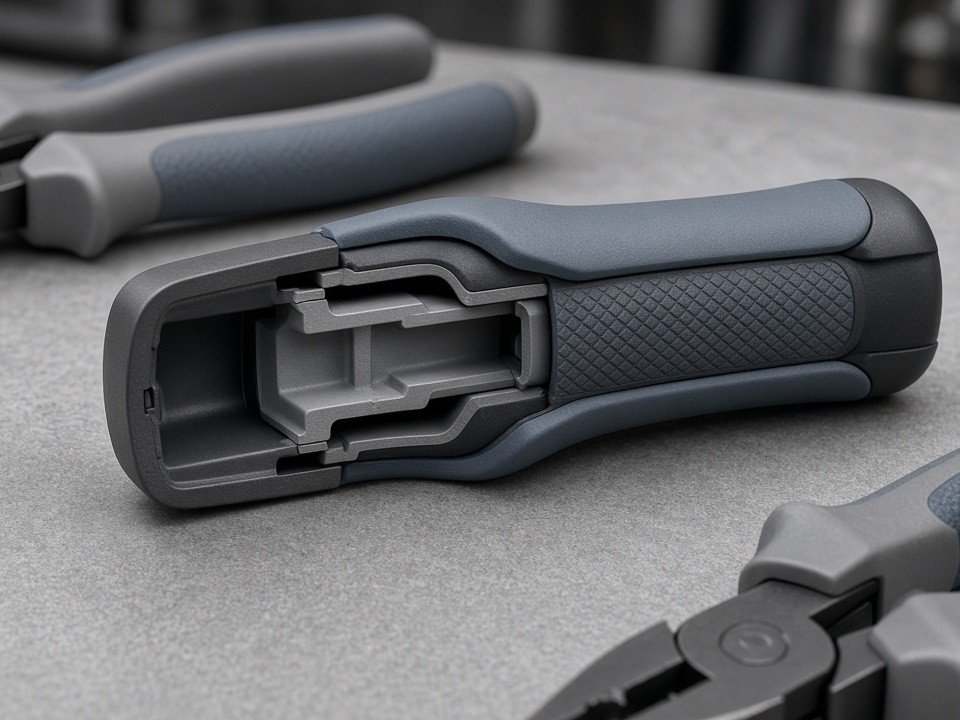
Add a soft-touch grip, integrated seal, vibration-damping feature, or protective layer to a rigid component. BGCNC coordinates custom overmolding through a network of proven manufacturing partners in Dongguan, China.
Our 10 manufacturing engineers review your substrate, overmold material, bonding approach, part geometry, and production quantity before tooling begins. We coordinate the rigid component and overmolding production through one point of contact.
10
Manufacturing engineers
50+
Evaluated manufacturing partners
Grip
Softer surfaces for handles, knobs, and controls.
Sealing
Integrated features that may reduce separate components.
Impact management
Compliant material in areas exposed to contact, movement, or shock.
Protection
A second material covering selected edges or surfaces.
Performance depends on the material pair, geometry, and molding process. Some combinations bond during molding; others may need mechanical retention features or validation testing.
Before tooling
Engineering review built around your part
Tooling decisions affect function, appearance, cost, and repeatability. Our engineers assess the design and proposed material combination before the project moves toward production tooling.
Select a review area to see the questions we consider.
Substrate and overmold compatibility
We check the proposed rigid resin or insert material against the selected overmold material and molding route. Bond strength can depend on specific grades and processing conditions. Where a reliable chemical bond cannot be assumed, the design may need mechanical retention features or validation testing.
Bonding area, part geometry, and mold loading
We review where the overmold begins and ends, how it wraps around the substrate, and whether the geometry supports consistent molding. Parting lines, shutoffs, thin sections, corners, transitions, insert positioning, and material flow all affect manufacturability and appearance.
Tolerances and inspection planning
We identify dimensions affecting fit, sealing, alignment, and function, then review how they should be measured. Material traceability, inspection records, and certification requirements can inform supplier selection. Certification availability and scope depend on the selected manufacturing partner.
Coordinated production
One route from substrate to finished part
Overmolding may involve substrate production, preparation, insert loading, molding, and inspection. Coordinating each step through separate suppliers can add communication and quality risks.
You work with one BGCNC team for engineering communication, supplier coordination, and production follow-up—reducing the work of managing a second supply chain.
-
01
Assess the design and manufacturing route
Review the substrate, overmold material, geometry, quality needs, quantity, lead time, and target cost.
-
02
Coordinate substrate and overmolding
Match suitable partners for CNC machining, injection molding and tooling, insert loading, and secondary operations where appropriate.
-
03
Follow through to delivery
Coordinate finishing, assembly, inspection, packaging, and international logistics according to project requirements.
Our network includes more than 50 proven manufacturers, selected and evaluated through project cooperation. Resources are matched to each part’s requirements.
RFQ preparation
Project details that help us evaluate your part
Share what you know about the material pair, intended use, and production needs. Final material, tooling, and process recommendations depend on the part design and application.
| Project parameter | Information to provide | Why it matters |
|---|---|---|
| Rigid substrate | Material, part drawing, and whether it is molded, machined, or supplied as an insert | Helps assess process fit and material compatibility |
| Overmold material | Preferred material or required feel, flexibility, hardness, and environmental conditions | Guides material selection and bonding review |
| Overmold area | CAD model or drawing showing the areas to be covered | Defines the molding interface and geometry to assess |
| Bonding requirement | Chemical bond, mechanical retention, or known functional requirement | Indicates whether design features or validation may be needed |
| Quantity and demand | Prototype quantity, initial order, and estimated repeat volume | Supports tooling and unit-cost comparisons |
| Critical dimensions | Fit, sealing, alignment, and other function-critical dimensions | Establishes what needs control and inspection |
| Finish and appearance | Color, texture, visible surfaces, and cosmetic expectations | Helps align tooling and inspection approach |
| Quality documentation | Inspection, traceability, or certification requirements | Informs partner selection and project controls |
We confirm feasible tolerances and production details during engineering review rather than applying a generic specification to every part.
Process selection
Is overmolding the right fit?
Overmolding is worth evaluating when a part needs a functional or tactile material layer that is difficult to achieve with a separate sleeve, pad, or assembled component. Potential applications include control handles, protective housings, instrument components, and custom hardware with integrated grip or sealing features.
It is not automatically the best option. A separate gasket or bonded component may be more practical for low quantities, frequent design changes, or material combinations that are difficult to bond.
Compare the options before investing
For early prototypes, machining or 3D printing can help verify form and fit, though these methods may not reproduce final overmold material behavior. Our engineers compare design, material, volume, tolerance, tooling investment, unit cost, lead time, and product lifecycle.
If demand is expected to grow, we can review whether the initial prototype route should transition to a different production process.
Discuss your production routeProject support
From design review to production coordination
For projects involving multiple custom parts or manufacturing processes, one coordinated team can reduce supplier-management work and provide a clearer channel for technical and production questions.
- Engineering and design-for-manufacturing review
- Substrate and overmold material assessment
- Process and supplier selection
- Tooling and production coordination
- Prototype and production order management
- Quality inspection coordination
- Surface finishing, assembly, and packaging
- International logistics support
Request an overmolding quote
Send your drawings for an engineering review
Share your part drawing or 3D CAD files, target quantity, substrate and overmold material preferences, and any critical performance or inspection requirements. If the material combination or bonding method is not defined yet, tell us how the part will be used so our engineers can identify questions to resolve before tooling.
Contact BGCNC at info@bgcnc.com.
Company address
Hongrongyuan · Honghu-Technologiepark, Bezirk Longhua, Shenzhen, China