
Low-Expansion Alloy · Precision CNC
Invar 36 CNC Machining for Dimensionally Stable Parts
BGCNC coordinates custom Invar 36 CNC machining for precision instruments, optical assemblies, metrology equipment and other applications where temperature-related dimensional change can affect function.
Send us your drawings and requirements. We review the material, geometry, tolerances, inspection needs and production quantity, then match the work to a suitable manufacturing partner in China.
- Partners
- 50+
- Engineers
- 10
- Axes
- 3–5
- Systems
- ISO / AS
Where Invar 36 Makes a Difference
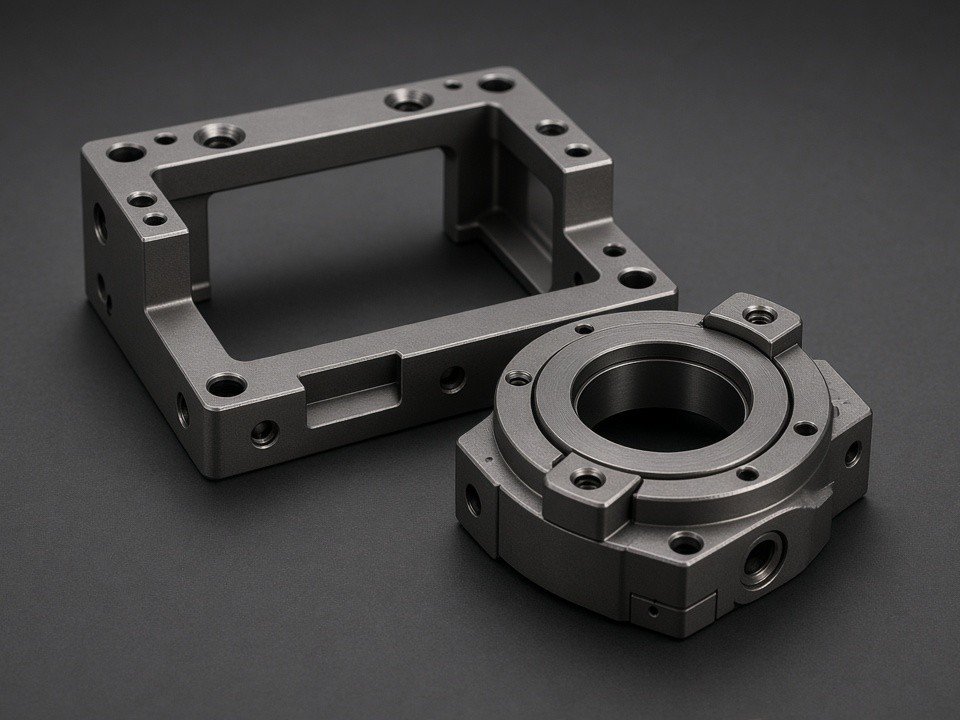
Invar 36 is a nickel-iron alloy selected for its low coefficient of thermal expansion over a defined temperature range. Compared with many common metals, it can change dimensions less as temperature changes, helping protect alignment, spacing or measurement relationships in an assembly.
The benefit depends on the application. Invar 36 is not automatically the right choice for every precision part. We consider the operating temperature range, thermal gradients, assembly interfaces and required dimensional stability before recommending a manufacturing route.
-
Optical benches & mounts
Support structures that hold alignment across temperature swings.
-
Metrology equipment
Measurement and reference components where drift matters.
-
Precision instrument frames
Frames and reference parts that must retain critical spacing.
-
Temperature-sensitive assemblies
Structural parts used near sensors or optics.
What We Review Before Quoting
A drawing alone may not show why a dimension matters. For an Invar 36 RFQ, we ask about the function of critical features as well as their nominal dimensions.
If a tolerance is unusually tight, we flag it for discussion rather than assume it can be achieved at a reasonable cost without additional process controls.
01
Material & condition
Grade, condition and any required certification.
02
Temperature range
Operating and inspection temperatures.
03
Critical geometry
Datums, fits, flatness and positional relationships.
04
Finish & coating
Surface finish and finishing requirements.
05
Volume & schedule
Part quantity, repeat demand and delivery target.
06
Documentation
Inspection records, traceability and packaging needs.
CNC Milling and Turning for Invar 36
Our manufacturing network supports CNC milling and turning, including 3-, 4- and 5-axis machining. We match each part to a partner based on geometry, material, tolerance, quantity, capacity and quality requirements—not simply to one factory’s available equipment.
Milling
- Pockets, slots, mounting faces and complex contours
- Multi-axis machining to reduce setups on complex parts
- Setup strategy and feature sequence planned to help control distortion
Managing Stress, Sequence and Dimensional Accuracy
Low thermal expansion does not eliminate machining-related dimensional risk. Material condition, stock removal, part geometry, clamping force and heat generated during cutting can all affect the result.
Stress-relief treatment must be defined with the material condition and application in mind. It can affect cost, lead time and material properties, so we do not assume it is required—or promise a particular result—without reviewing the project requirements.
-
Roughing and finishing sequence
Planned to separate bulk removal from final dimension control.
-
Stock allowance and intermediate checks
Allows verification before final machining of critical features.
-
Workholding that limits distortion
Clamping strategy matched to part geometry.
-
Stress-relief or stabilization steps
Applied only when specified and suitable for the material condition.
-
Inspection method and measurement temperature
Agreed so acceptance criteria align with function.
Inspection and Documentation
We coordinate inspection requirements with the selected manufacturing partner before production. Depending on the project and the partner’s available systems, this may include dimensional inspection reports, material documentation, traceability records or other agreed quality documents.
For critical parts, tell us which features drive performance and how they will be verified. A clear inspection plan helps align the drawing, manufacturing process and acceptance criteria before parts are made.
Our wider partner network includes manufacturers operating under recognized quality systems, such as ISO 9001, AS9100D, IATF 16949 and ISO 13485. Certification availability and scope depend on the actual partner selected for the work; please identify any mandatory certification in your RFQ.
One Contact for More Than CNC
A precision assembly may combine Invar 36 components with parts made through other processes. Through our network of 50+ proven manufacturing partners, we can coordinate CNC machining alongside other relevant services, and our team of 10 manufacturing engineers reviews projects and helps coordinate suppliers, production, quality and delivery.
- Sheet metal fabrication, laser cutting, bending & welding
- Injection molding and tooling
- 3D printing for prototypes
- Die casting, forging, stamping & extrusion
- Investment casting, EDM and grinding
- Surface finishing and heat treatment
- Assembly, packaging & international logistics
When Invar 36 Is the Right Material—and When to Compare Options
Invar 36 may be appropriate when thermal expansion is a meaningful source of functional error and the design benefits from reduced dimensional change over its operating range. It may be less suitable when the low-expansion property is not needed, when other material requirements dominate, or when the added material and machining cost does not deliver a measurable benefit.
Where appropriate, we can review alternative materials or manufacturing approaches with you. We will not recommend Invar 36 solely because it is specified in an early concept if a different solution may meet the functional need more economically.
| Project consideration | Why it matters |
|---|---|
| Temperature range and gradients | Thermal behavior depends on the actual operating conditions, not only the material name. |
| Critical dimensions and function | Helps distinguish performance-critical tolerances from dimensions that can be relaxed. |
| Geometry and stock removal | Large or asymmetric material removal can complicate dimensional control. |
| Quantity and repeat demand | Affects supplier selection, process planning and unit cost. |
| Documentation and inspection | Can add process steps and should be agreed before production. |
| Total project cost | Material, machining, treatment, inspection and lead time all contribute. |
A Good Fit for Precision B2B Projects
We’re best suited to overseas hardware and industrial companies that need custom parts, repeat production or coordination across multiple processes. Typical project environments include robotics, automation, scientific equipment, instrumentation, optical systems, testing equipment and industrial machinery.
We focus on professional B2B projects where part performance, communication, reliable supply and total cost matter—not on one-off consumer or hobby orders.
- A mix of custom parts in low or medium volumes
- Technical communication during drawing review
- Coordination across suppliers or manufacturing processes
- Support from prototype builds through production
- Quality and delivery follow-up from one China-based contact
Send Your Invar 36 RFQ
To help us assess your project, include the 2D drawing and 3D model, if available, along with quantity, material condition, tolerances, operating temperature range, required documents and target delivery date. Please identify any dimensions tied directly to optical alignment, measurement accuracy or assembly performance.
We’ll review the information, raise questions where requirements need clarification and coordinate a suitable manufacturing route and quotation through our partner network.
Email: info@bgcnc.com
Address: Hongrongyuan · Honghu-Technologiepark, Bezirk Longhua, Shenzhen, China