Casting
When volumes grow, machining every part from solid stock stops being the economical route. BGCNC helps engineers and procurement teams decide when to move from all-CNC production to casting plus CNC finishing — coordinating die casting, investment casting and sand casting with the machining, heat treatment and surface finishing that bring a part to specification.
- 50+
- Proven manufacturing partners
- 10
- Manufacturing engineers
- 1
- Integrated supply chain interface
Tooling, volume and unit cost
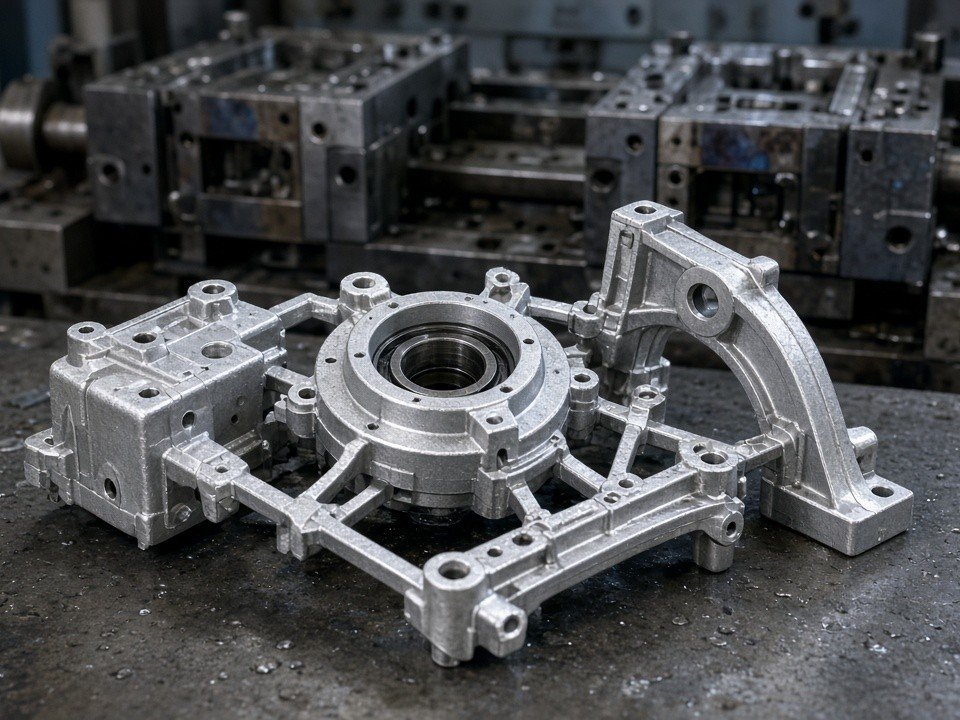
Casting changes the economics of a part: mold investment is amortized across production quantity, while secondary CNC machining holds critical dimensions and tolerances. The right balance depends on geometry, material, annual volume, precision and product lifecycle.
- Die casting for medium-to-high volume aluminum, zinc and magnesium parts
- Investment casting for complex stainless and alloy steel components
- Sand casting for large, heavy-walled or difficult-to-machine geometry
- CNC finishing, heat treatment and surface finishing coordinated in one place
When casting plus CNC becomes the better route
This section answers a practical question rather than teaching casting theory: at what point does moving away from 100% CNC machining reduce total cost without compromising quality? BGCNC engineers evaluate design, material, volume, tolerance, tooling, unit cost, lead time and product lifecycle together before recommending a manufacturing path.
Prototype to low volume
CNC machining from solid stock usually avoids tooling investment and shortens lead time. It remains the most flexible option when design changes are still frequent or quantities stay small.
Medium volume
Die casting and investment casting start to pay back tooling investment as repeat quantity grows. Critical features are then finished by CNC to hold tolerances and surface requirements.
Higher volume production
Mold amortization lowers unit cost, and process selection shifts toward die casting, forging plus secondary machining or stamping depending on geometry, material and structural requirements.
What BGCNC manages for casting projects
Instead of managing a foundry, a machine shop, a heat treatment vendor and a finishing supplier separately, customers work with one BGCNC team while we coordinate engineering, suppliers, production, quality and delivery.
Supplier matching
Each project is matched to partners selected for capability, quality consistency, delivery performance, engineering capability, cost competitiveness, responsiveness, problem solving, capacity and long-term reliability.
Tooling and production management
Mold development, sampling, first article review and production scheduling are coordinated so tooling investment and unit cost stay aligned with the expected order profile.
Dimensional and defect control
Inspection documentation, material traceability and defect review help keep quality consistent between batches and between suppliers.
Process and cost optimization
Engineers review whether tolerances are unnecessarily tight, whether the design can be simplified, and whether secondary operations can be reduced without affecting function.
Certified supply chain options
Depending on project requirements, partners operating under AS9100D, IATF 16949, ISO 13485 or ISO 9001 quality systems can be selected. Certification availability and scope depend on the actual partner chosen.
Long-term supply continuity
For customers with ongoing purchasing plans, we support repeat orders, drawing revisions, assembly, packaging and international logistics coordination.
Built for high-mix, multi-process casting programs
Our ideal customers are small and mid-sized B2B hardware and industrial companies in the United States, Canada, Europe, Australia and other international markets — typically 10 to 200 employees in robotics, automation, industrial equipment, electronics, instrumentation, drones, testing and scientific equipment.
Their real challenge is rarely finding a factory. It is managing a reliable manufacturing supply chain in China across multiple suppliers, processes and production batches.
Discuss Your Casting ProjectTypical order profile
- High-mix, low- to medium-volume production
- Multiple SKUs and multiple manufacturing processes
- Typical quantity of 5 to 5,000 pieces
- Typical order value of USD 1,000 to 30,000
- Annual purchasing potential of USD 30,000 to 1,000,000+
What buyers prioritize
- Quality and dimensional consistency
- Lead time and delivery reliability
- Clear technical communication
- Supply reliability across repeat orders
- Total cost rather than the lowest unit price
Pain points we help remove
Managing multiple suppliers in China
Identifying the right supplier per project
Drawing misunderstandings and communication gaps
Coordinating multiple manufacturing processes
Quality inconsistency between batches
Limited production visibility
Quality problems and delivery delays
High supplier management and sourcing cost
Casting topics and process guides
Browse our casting articles on die casting, aluminum and zinc die casting, investment casting and sand casting. Each guide covers process selection, material and tolerance considerations, tooling implications and how BGCNC coordinates casting with CNC finishing, heat treatment and surface finishing.
Custom Die Casting Services | Precision Manufacturing & Supply Chain | BGCNC
Scale your production with BGCNC’s expert die casting services. We optimize tooling costs, secondary CNC machining, and surface finishing for high-volume parts.
View details →
Aluminum Die Casting Services | CNC Finishing & Assembly
Source aluminum die cast housings, heat sinks and structural parts with CNC finishing, coating and assembly coordinated by BGCNC. Request a project review.
View details →
Zinc Die Casting Services for Custom Parts | BGCNC
Source custom zinc die cast parts with coordinated tooling, production, finishing and assembly. Send your drawings to BGCNC for a project review.
View details →
Investment Casting Services for Custom Metal Parts | BGCNC
Source custom investment castings in stainless and alloy steel. BGCNC coordinates casting, heat treatment, CNC finishing and quality for B2B projects.
View details →
Sand Casting Services | Custom Large-Scale Metal Parts | BGCNC
BGCNC provides high-quality sand casting services for large, complex metal components. Optimize your production costs with our expert engineering support.
View details →Talk to a manufacturing engineer
Send us your drawings, target quantities and quality requirements. BGCNC will review whether casting plus CNC finishing is more economical than machining from solid stock, and outline the tooling, unit cost and lead time implications.
- Engineering review and DFM analysis
- Process selection and cost optimization
- One integrated manufacturing and supply chain interface in China
Better Manufacturing in China. Your Global Partner.
Request a quote
Share your project details and our team will respond with a manufacturing recommendation.